
A car loan in Pakistan is sold on one number: the monthly instalment. The bank's ad shows you Rs 60,000 a month and your brain files the car under "affordable". The instalment is real, but it is only about half the bill. Between the markup, the insurance you must buy every year, the tracker fee, the registration and withholding tax, and the value the car loses while you are still paying for it, a financed car routinely costs Rs 10–18 lakh more than its showroom price. This guide puts the whole bill on one page, with the State Bank's 2026 rules, the rates banks are actually quoting this month, and three worked examples — a new Alto, a new Yaris, and a used Cultus — so you can see which route leaves the most money in your pocket.

Car loan in Pakistan: the SBP rules that decide what you can borrow
Before any bank quotes you a rate, the State Bank of Pakistan (SBP) has already decided most of the shape of your loan. These are the Prudential Regulations for Consumer Financing, and every bank follows them:
- •The Rs 30 lakh cap. Your total car financing across all banks combined cannot exceed Rs 3,000,000. This single rule kills more Sportage and Yaris plans than any interest rate — more on that below.
- •Down payment. For locally made cars up to 1000cc, the minimum down payment is 15% and the maximum tenure is 5 years. For cars above 1000cc, the minimum down payment is 30% and the maximum tenure is just 3 years.
- •The 40% income rule. Your total car instalments cannot exceed 40% of your net monthly income. On a Rs 200,000 salary, the ceiling is Rs 80,000 a month — and banks count your other loans against it too.
- •One person, one cap. The Rs 30 lakh limit is per person, not per bank. Splitting a loan across two banks to dodge it does not work; banks check your eCIB record.
Two practical consequences. First, a small car is not just cheaper to buy — it is cheaper to finance, because the 5-year tenure spreads the same markup thinner. Second, anyone eyeing a car above roughly Rs 4.3 million needs a much bigger deposit than the 30% minimum suggests, because the cap, not the percentage, becomes the binding constraint.
What banks actually charge in November 2026
Car loans in Pakistan are priced off 1-year KIBOR — the Karachi Interbank Offered Rate — plus the bank's margin. In early October 2026, 1-year KIBOR stood around 12.75%, drifting to about 13.04% by early November. That is why almost every bank's car rate clusters between 14% and 17% right now, and why any quote far below that deserves a second look (it is usually a short campaign rate, like HBL's 11.99% offer that ran to 30 September 2026).
Indicative November 2026 rates from published bank pricing:
| Bank / product | Type | Indicative rate |
|---|---|---|
| HBL CarLoan | Conventional | ~13.5% |
| Bank of Punjab | Conventional | ~14.1–14.4% |
| Meezan Car Ijarah | Islamic (Ijarah) | ~14.65–15% |
| Bank AL Habib Apni Car | Conventional | ~15.25–16.25% |
| UBL Drive | Conventional | ~16.25–17% |
| MCB Car4U | Conventional | ~16.75–17.25% |
| Bank Alfalah Auto Loan | Conventional | ~16.25–17.25% |
Treat every figure as indicative: your final rate depends on your income, your eCIB history, whether you already bank there, and the KIBOR fixing on your bank's reference date. The rule that saves real money is simple — get three written quotes before you sign anything. A 2 percentage-point gap on a Rs 2.5 million loan is roughly Rs 150,000 over five years, and banks know most buyers never ask a second one. If you are weighing a loan against a house purchase instead, our comparison of Apna Ghar loan vs bank home loan in Pakistan 2026 shows how the same rate-shopping logic works on a much bigger number.
Worked example 1: Suzuki Alto — the cheapest route into a new car
The Alto (660cc) is the only mainstream new car that gets the friendly end of the SBP rules: 15% down, 5 years to pay. Take an illustrative Rs 3,000,000 on-road price:
- •Down payment (15%): Rs 450,000
- •Loan: Rs 2,550,000 at 15% for 60 months
- •Monthly instalment: about Rs 60,700
- •Total paid over 5 years: about Rs 3,642,000
- •Markup alone: about Rs 1,092,000
So the "Rs 30 lakh car" costs roughly Rs 4,092,000 all-in before insurance — and insurance at roughly 3% of value a year adds another Rs 70,000–90,000 in year one, falling as the car's value falls. The Alto's real advantage is not the price tag; it is the 5-year tenure. Stretch the same loan over 3 years and the instalment jumps past Rs 87,000 — beyond the 40% rule for most salaried buyers. If your salary is under Rs 220,000 a month, the Alto on 5 years is often the only new car the income rule actually allows.
Worked example 2: Toyota Yaris — where the Rs 30 lakh cap bites
The Yaris (1300cc+) sits at the harsh end: 30% down, 3 years maximum. Take an illustrative Rs 4,500,000 price:
- •30% down payment: Rs 1,350,000 — but the loan needed would be Rs 3,150,000, which breaks the Rs 30 lakh cap
- •Real minimum down payment: Rs 1,500,000, leaving a Rs 3,000,000 loan
- •Loan: Rs 3,000,000 at 15.5% for 36 months
- •Monthly instalment: about Rs 104,800
- •Total paid over 3 years: about Rs 3,772,000
- •Markup alone: about Rs 772,000
Two lessons. First, the cap quietly raises your deposit: budget 33–35% down on any car above Rs 4.3 million, not 30%. Second, the 3-year tenure is brutal on cash flow — Rs 104,800 a month needs a net income above Rs 262,000 under the 40% rule. Many Yaris buyers who "qualify" on the bank's website discover at the branch that they do not. And remember the insurance bill rides on top every year: our car insurance cost guide for 2026 puts comprehensive cover by car, and on a Yaris-class car it runs well into five figures annually — the bank will not let you skip it, because the car is their security until the last instalment clears.
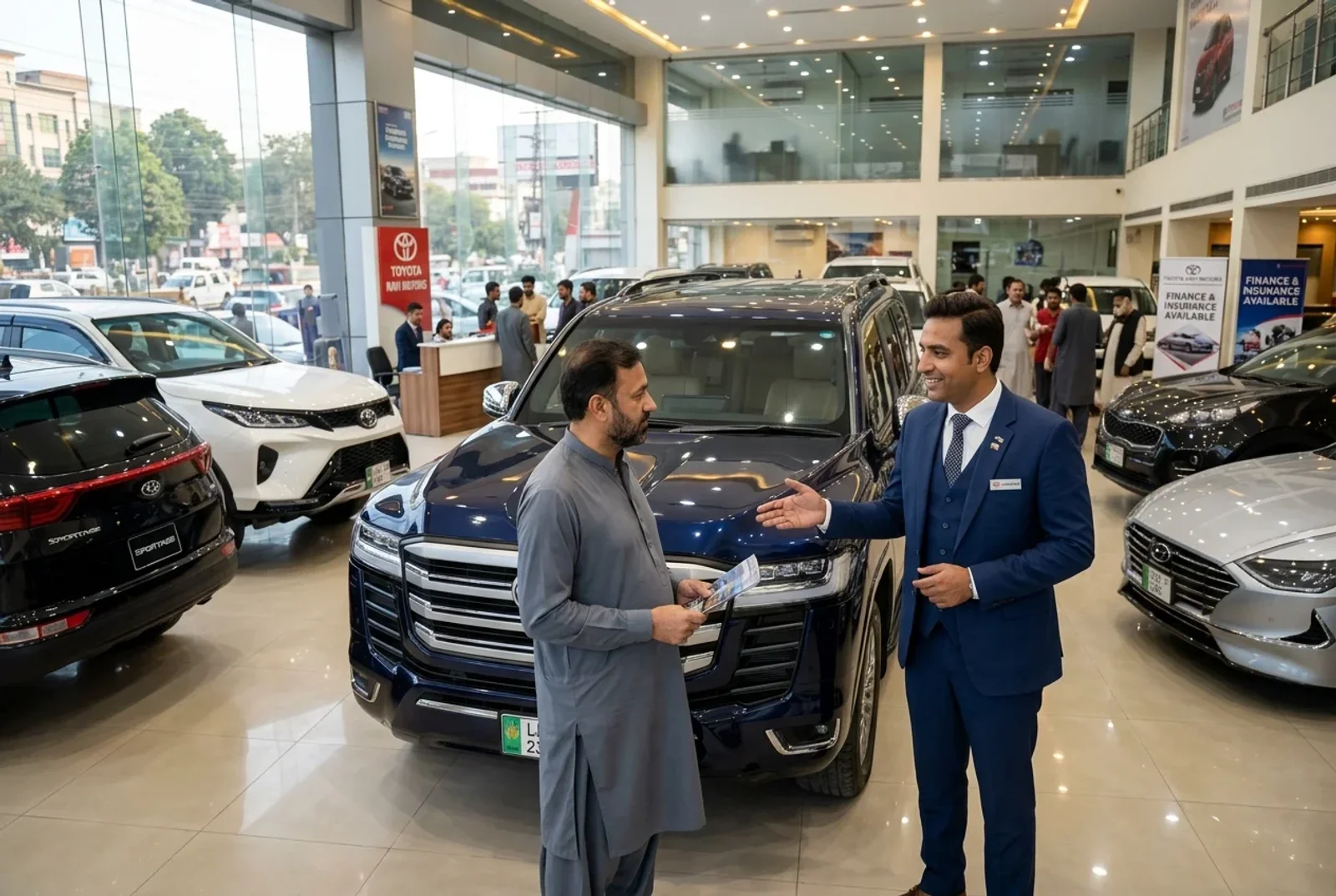
Worked example 3: a used Cultus — the route banks rarely advertise
Here is the option almost no bank ad mentions: finance a used car. A 3–4 year old Cultus at an illustrative Rs 2,000,000, financed at a higher 17% over 3 years (used cars get shorter tenures and slightly higher rates):
- •Down payment (30%): Rs 600,000
- •Loan: Rs 1,400,000 at 17% for 36 months
- •Monthly instalment: about Rs 49,900
- •Total paid over 3 years: about Rs 1,798,000
- •Markup alone: about Rs 398,000
Compare the totals. The used Cultus costs Rs 2,398,000 all-in (deposit + payments) versus Rs 4,092,000 for the new Alto — and the Cultus has already taken its biggest depreciation hit, so what you own at the end holds its value better. The trade-offs are real: older cars need more maintenance, banks cap the car's age (usually 5–7 years at loan end), and you must verify the car is clear of bank liens and token-tax arrears before the bank releases a rupee. But for a buyer whose real need is reliable transport rather than a new-car smell, the used route is routinely Rs 10 lakh+ cheaper — which is why it deserves a quote alongside every new-car quote you collect.
The hidden bills: insurance, tracker, registration, early settlement
The instalment is the headline; these are the footnotes that add up to lakhs:
- •Insurance, every year. Comprehensive cover is mandatory on a financed car, typically 2.5–4% of the car's value annually. Over five years that is Rs 3–4 lakh on a mid-range car — and it is not in the instalment.
- •Tracker. Most banks require a tracker: roughly Rs 12,000–20,000 a year plus installation. Miss a payment and some trackers immobilise the car.
- •Registration and withholding tax. Registration, number plates and filer/non-filer WHT are paid by you, on top of the showroom price. Non-filers pay multiples of the filer rate — one more reason the filer math in our personal loans comparison matters beyond loans.
- •Processing and documentation fees. Typically Rs 5,000–15,000 upfront, plus valuation charges on used cars.
- •Early settlement charges. Pay the loan off early and most banks charge 2–5% of the outstanding amount. A "flexible" loan that punishes early repayment is not flexible — ask for this clause in writing before signing.
Add them up for the Alto example: five years of insurance and tracker alone add roughly Rs 4–5 lakh to the Rs 4,092,000 figure. The true 5-year cost of that "Rs 30 lakh car" is closer to Rs 4.5 million.
Islamic vs conventional: same price, different contract
Meezan's Car Ijarah, BankIslami's AutoFinance and similar products are Shariah-compliant, but do not expect them to be cheaper: the same banks price Islamic and conventional versions off the same KIBOR benchmark, and published comparisons show identical spreads at several banks. The difference is the contract — Ijarah is a lease (the bank owns the car and rents it to you) while a conventional loan is a markup on money lent — not the monthly number. Choose on the basis of your faith and the contract terms, not on a promised saving that the rate sheet does not show. Either way, the SBP cap, tenure limits and 40% income rule apply identically.
The decision: loan, save up, or buy used?
Run this three-question test before you sign:
- 1.Does the instalment fit the 40% rule with insurance included? If instalment + monthly insurance share exceeds 40% of net income, the loan is too big — drop a segment, not your savings.
- 2.Is the car above Rs 4.3 million? If yes, budget a 33–35% deposit because of the cap, and check you can carry a 3-year instalment.
- 3.Could a 3-year-old car do the same job? If yes, price the used route first. The saving is usually the largest single financial decision in the whole purchase — bigger than haggling over the interest rate.
Saving up instead of borrowing still wins on pure cost: the Alto buyer who saves Rs 60,700 a month for 42 months has the car with zero markup. But saving takes discipline and time, and for many families the car earns its keep (a job commute, a business delivery run) from month one. The honest middle path is the one this guide keeps returning to: the smallest car that does the job, the biggest deposit you can manage, and three competing quotes.
How to apply without getting rejected

Rejections are usually paperwork, not income. Banks typically ask for: CNIC, 6 months' bank statements, salary slips or business proof, NTN where applicable, and the car's quotation or sale deed. Three rejection traps: a salary account at a different bank with no salary credits visible, an eCIB record with a settled-but-unclosed old loan, and applying for a loan above the 40% rule and hoping the branch overlooks it. Fix the eCIB entry first, route your salary visibly for a few months if you can, and apply to the bank where your salary already lands — existing-customer rates are consistently 0.5–1 point lower.
One last number to carry to the branch: the total cost, not the instalment. Ask the bank to print the full schedule — instalment, total markup, insurance years one to three, tracker, and early-settlement charge — and compare that page across banks. The cheapest instalment is rarely the cheapest loan, and the bank printing the fullest schedule is usually the one worth signing with. You can build that schedule yourself before you go: the free Amortization Calculator lays out every payment month by month, and the Personal Loan Calculator prices any loan offer with its fees counted.
If your business needs a website that sells while you sleep, see what WebStore Pro builds for Pakistani businesses — or start with the numbers above and make the bank compete for your signature.
Need a website?
Let's build yours — in days, not months.
Our services
What WebStore Pro builds for businesses like yours
- Full Stack Web Development →
Complete websites and web applications built end to end — frontend, backend, database and admin panel — fast, secure and ready to grow.
- Business Website →
Professional company website with services, portfolio, contact forms and everything your brand needs online.
- Admin Panel →
Easy dashboard to add products, update prices and track orders yourself — no coding knowledge required.
- Payment Integration →
Stripe, PayPal, JazzCash and more — accept online payments securely with your own merchant account.
- WhatsApp Ordering →
Let customers order directly through WhatsApp with one tap — perfect for small businesses and local shops.
- SEO Basics →
Search-friendly structure, fast loading and proper meta tags so customers can actually find you on Google.